
Carrier-Grade Wireless vs. Consumer-Grade: What's the Real Difference?

AO WIRELESS FIELD INTELLIGENCE SERIES | PART 2 OF 5
Every wireless vendor proposal looks similar on paper. The difference between carrier-grade infrastructure and 'good enough' infrastructure isn't visible at installation. It shows up at year two — when the first real stress event hits.
The phrase 'carrier-grade' gets used frequently in wireless infrastructure conversations and like most frequently-used phrases, it has lost some precision. IT directors and CIOs evaluating wireless network proposals deserve a clear definition of what carrier-grade actually means in practice, and how to identify whether a proposal delivers it.
At Alpha Omega Wireless, carrier-grade describes a specific set of engineering disciplines applied consistently across four dimensions: spectrum management, redundancy architecture, operational documentation, and long-term supportability. This article examines each one, explains how consumer-grade or 'good enough' approaches compare, and gives you specific evaluation criteria to apply when reviewing proposals.
Dimension 1: Licensed vs. Unlicensed Spectrum
Wireless networks operate in either licensed or unlicensed radio frequency spectrum. Understanding the difference is foundational to evaluating wireless network reliability.
Unlicensed Spectrum
Unlicensed bands — including 2.4 GHz, 5 GHz, 6 GHz, and 900 MHz — are available for use by anyone without an FCC license. Equipment operating in these bands must accept interference from other users and cannot cause harmful interference to others. There is no regulatory protection if a neighbor's new wireless deployment degrades your network.
Unlicensed spectrum is cost-effective and can be engineered for strong performance in favorable environments. It's appropriate for many applications: campus mesh networks, temporary deployments, lower-priority links where some degradation is tolerable, and environments where the RF is well-controlled.
Licensed Spectrum
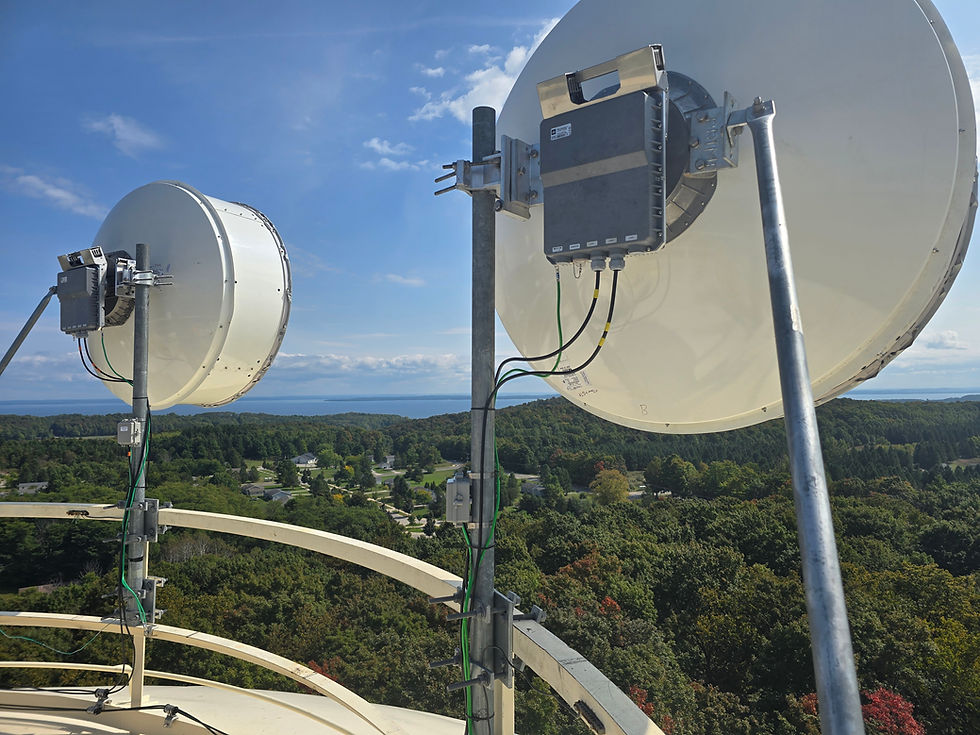
Licensed microwave spectrum — including 6 GHz, 11 GHz, 18 GHz, and 23 GHz bands — requires FCC coordination and a site-specific frequency assignment. That assignment gives you regulatory protection: no other user can operate on your frequency in your coverage area. If interference occurs, you have regulatory recourse.
For mission-critical applications — public safety communications, utility SCADA, primary municipal network backhaul — licensed spectrum provides a level of reliability assurance that unlicensed spectrum cannot match. Licensed microwave systems, properly engineered, routinely achieve 99.999% link availability.
Licensed spectrum is an uptime insurance policy. The premium is the frequency coordination cost. The payout is a protected, interference-free link when you need it most — during emergencies, when RF environments get congested.
CBRS: The Middle Ground
CBRS (Citizens Broadband Radio Service) in the 3.5 GHz band sits between traditional licensed and unlicensed spectrum. Priority Access License (PAL) spectrum provides interference protection for specific geographic areas. General Authorized Access (GAA) tier provides less protection but is available without license purchase costs. CBRS is well-suited for private LTE networks, distributed IoT applications, and fixed wireless access where the link budget and interference environment support it.
We cover CBRS in detail in Part 3 of this series.
Dimension 2: Engineered Redundancy vs. a Backup Plan
Redundancy is another term that sounds similar across proposals but represents vastly different realities.
What 'Good Enough' Redundancy Looks Like
Consumer-grade or 'good enough' redundancy typically means one of the following: a spare radio on the shelf, a second link that runs on the same physical infrastructure as the primary, or a verbal commitment to rapid response if the network goes down. None of these constitute network redundancy in the engineering sense.
A second link that runs on the same pole, the same power feed, and the same conduit fails under the same conditions as the primary. A spare radio that takes four hours to configure during an outage is a recovery plan — not redundancy. A response-time SLA measures how fast someone shows up after the outage, not whether the network stays up.
What Carrier-Grade Redundancy Looks Like
Ring topologies that allow traffic to route around any single point of failure — when one link in the ring fails, the network self-heals in milliseconds using Rapid Spanning Tree Protocol or similar, with no operator intervention required
Physically diverse paths — redundant links that don't share poles, conduit runs, power infrastructure, or geographic corridors
1+1 equipment protection on mission-critical point-to-point links — a hot-standby radio that assumes the primary link's traffic in sub-second failover time
Generator or solar backup with automatic transfer switching — not 'we can get a generator there within two hours'
Out-of-band management paths that allow remote access to network equipment even when the primary data path is down, eliminating the need for truck rolls to diagnose failures
The test of a redundancy design: trace any single failure — link, power supply, equipment unit, physical structure — and identify how traffic continues to flow. If the answer involves a technician with a truck, that's not redundancy. It's a response plan.
Dimension 3: Audit-Ready Documentation vs. Tribal Knowledge
Documentation is the dimension that creates the most long-term operational risk and the one least likely to appear in a proposal comparison.
A carrier-grade wireless deployment generates a comprehensive documentation package at project close: as-built drawings with accurate pole coordinates and equipment placement, FCC frequency coordination records, equipment serial numbers and firmware versions, configuration backups in a secure repository, RF link budget calculations for each path, structural assessment records, grounding and bonding certification, and a network management system with historical performance data.
This documentation survives personnel changes, vendor transitions, and technology refresh cycles. When a new IT director or network administrator takes over the system, they inherit a network they can understand, manage, and optimize.
The alternative — which we encounter regularly when we're brought in to assess or remediate existing networks — is a SharePoint folder with three vendor PDFs, equipment configurations that exist only on the radios themselves, and institutional knowledge that departed with the person who built the network two years ago.
Documentation isn't overhead. It's the mechanism by which your network survives personnel changes, vendor changes, and technology refresh. For networks carrying public safety or federally-funded infrastructure, it's also an audit requirement.
Dimension 4: Long-Term Supportability
The acquisition cost of wireless infrastructure is a fraction of the total cost of ownership over a 10-year lifecycle. Equipment selection, support contract terms, and manufacturer relationships determine what the real cost looks like.
Carrier-grade wireless equipment manufacturers — Cambium Networks, Ericsson, Motorola Solutions, Siklu, and select others — maintain long product support windows, predictable firmware update cycles with documented security patch schedules, available spare parts throughout the product lifecycle, and responsive technical support organizations.
The supportability questions to ask any wireless vendor:
What is the manufacturer's stated end-of-life timeline for this product line?
What is the security patching cadence, and how are patches distributed and tracked?
Who manages firmware updates post-deployment — your team, or the vendor?
Where are configuration backups stored, and who has access?
What is the parts availability commitment if hardware needs replacement in year 5?
How to Identify Carrier-Grade Work in a Wireless Proposal
You don't need to be a wireless engineer to evaluate whether a proposal reflects carrier-grade engineering discipline. Look for the following deliverables — and treat their absence as information:
A pre-deployment site survey and spectrum analysis report — not just coverage predictions from a software modeling tool
A frequency coordination plan that addresses both licensed and unlicensed spectrum strategy
RF link budget calculations for every point-to-point or backhaul segment
A redundancy design document that traces traffic routing through specific failure scenarios
A power system design showing load calculations, sizing rationale, and battery autonomy figures
Grounding and bonding specifications referenced to a recognized standard
A documentation deliverable list — what the organization receives at project close, in what format, in whose possession
A support and maintenance plan with defined response times, firmware management responsibilities, and escalation procedures
A proposal that addresses these elements verbally but not in writing is a carrier-grade gap in a good-enough wrapper. The savings on day one will be spent on remediation before year three.
Frequently Asked Questions: Carrier-Grade Wireless Infrastructure
What makes a wireless network 'carrier-grade'?
Carrier-grade wireless networks are characterized by licensed spectrum use (or engineered unlicensed spectrum with documented frequency plans), physically diverse redundancy architectures, comprehensive as-built documentation, and equipment from manufacturers with long product support windows. The defining standard is that the network is engineered for a specific, documented availability level — not simply deployed and hoped to perform.
What is the difference between licensed and unlicensed wireless spectrum?
Licensed spectrum requires an FCC frequency assignment and provides regulatory protection against interference from other users. Unlicensed spectrum is available without a license but provides no interference protection — any adjacent user can legally degrade your signal. For mission-critical wireless links, licensed spectrum provides reliability assurance that unlicensed bands cannot.
What is 99.999% wireless availability, and how is it achieved?
99.999% availability (five-nines) means less than 5.26 minutes of unplanned downtime per year. It is achieved through a combination of licensed spectrum (interference protection), engineered fade margin in the link budget (weather resilience), 1+1 equipment protection (hardware redundancy), and reliable power systems. It is an engineering outcome, not a product feature.
How does wireless network documentation affect long-term reliability?
Comprehensive documentation — as-built drawings, frequency records, configuration backups, link budgets — is what allows a network to be properly maintained, optimized, and expanded after the original deployment team moves on. Networks without documentation are managed reactively and degraded over time by well-intentioned changes that weren't understood in context.
What should I look for in a carrier-grade wireless network proposal?
Look for written deliverables, not verbal commitments: a spectrum analysis report, link budget calculations, a redundancy design document, a power system sizing document, grounding specifications, and a documentation deliverable list. Proposals that address these elements only in conversation represent good-enough work positioned as carrier-grade.
Have a wireless infrastructure project or just want a second opinion? Contact the AO Wireless engineering team at www.aowireless.com. No pressure — just straight talk from people who've built it.
Next: Part 3 — 5 Wireless Network Myths Public Agencies Still Believe. We address fiber-only thinking, CBRS misconceptions, and why the 'wireless isn't reliable enough' assumption is a decade out of date.


Comments