
Subscribe by Email

Your email:
www.flickr.com
Alpha Omega Wireless' items Go to Alpha Omega Wireless' photostream

Alpha Omega Wireless Blog

Current Articles | RSS Feed RSS Feed

Wireless Backhaul Can Prevent Network Outages

Share on Twitter Twitter | Share on Facebook Facebook | Submit to Digg digg it |  Add to delicious  delicious |  Submit to StumbleUpon StumbleUpon |  Share on LinkedIn LinkedIn |  Share On Technorati Technorati | Submit to Reddit reddit 

Wireless backhaul in the form of point to point microwave - licensed microwave links or unlicensed wireless Ethernet bridges, point to multipoint wireless Ethernet bridges, or wireless mesh network infrastructures can provide up to 99.999% reliability and keep you up and running when your telecommunications provider fails you.

Redundant Wireless backhaul Do you ever experience downtime on you network due to outages with your telecommunications provider, such as: AT&T, Verizon, or Comcast? What does a network outage cost you organization in dollars and man hours due to lack of productivity and internal communication or with clients? What do you say? This never happens? Think again!

You think you’re safe because you have a point to point fiber connection from your telecommunications vendor? Read my article “Outdoor Wireless Bridges or Fiber, Which Do You Trust.” What if you use an MPLS network, doesn’t that provide you failover redundancy? What about having different carriers for a backup connection? Or what about using cellular modems as a last result? Aren’t you protected by having redundancy? Not really!

The true fact is that the major telecommunications companies have outages all the time. December 11th, 2009 San Francisco experienced a several hour AT&T outage. July 21, 2010, AT&T Wireless had a regional outage for hours in NC. On April 9th, 2009 Santa Clara County, CA declared a local emergency when someone intentionally cut an underground fiber optic cable in South San Jose taking out cellular, internet, and phone usage to AT&T, Verizon, and Sprint/Nextel customers. This affected multiple cities. A local hospital had to cancel surgeries due to the emergency. Recently, Union City, CA experienced a city wide outage when central office went dark. All voice, internet, MPLS, cellular, etc. was out for almost 10 hours.

So what happens when you have no cellular, internet, data, or voice connectivity?  For some organizations they have critical operations that have to be monitored so they have to be physically manned if the network goes down. What’s the cost to deploy people to remote sites or work overtime during the middle of the night? What about lost data? Some organizations can run into the millions of dollars an hour during a network outage.

Too often organizations fail to ensure their communications, both data and voice, are protected by not having appropriate redundancy or just flat out relying on a third party telecommunications vendor. Many times those who have a redundancy solution in place don’t have “True Redundancy.” Many overlook their WAN connections or have single point of failures in using the same medium (such as fiber), or taking the same external routes (out the same conduits from their MPOE), or have unknown points of failure by relying on third party telco providers’ networks. You can have MPLS but if you first connect through a local central office and that CO goes dark there is an issue. Even with backup power central office have gone dark (recently in Union City, CA) and fiber lines have been cut (San Jose, CA).

Licensed Microwave LinkWireless backhaul connectivity, both point to point wireless links and point to multipoint wireless bridges, provide an avenue for extremely reliable primary connections and for creating “True Redundant” network paths and connections. With both unlicensed wireless Ethernet bridges or licensed microwave links, an organization can create a completely separate stand alone network and eliminate the dependency on third parties equipment and facilities, and remove the risk of failure of fiber cuts off site and out of an organizations control.

So why own your own wireless backhaul network? Wireless backhaul, with proper wireless path engineering, the use of the right outdoor wireless backhaul equipment, and proper wireless installation can provide truly reliable networks. See articles, “Is Wireless Reliable? - The 5 Misconceptions - Part 2” and “Outdoor Wireless Installation Done Properly.”

Wireless backhaul can have multiple advantages. Wireless networks can be used for primary or redundant links. Throughput can match or even exceed that of a leased line from a telco. You can get connectivity where you can’t get it from a telco for last mile solutions. Wireless backhaul typically has an extremely low ROI and can eliminate reoccurring lease line costs. Wireless installation can be done in days compared to months of provisioning time from a telco. Also with wireless backhaul you have complete control of your network. Even in the event of equipment failure wireless nodes can be restored quickly by simply hot swapping the radio communications equipment.

That’s right no more trouble tickets from some call center agent in another country!


Wireless Backhaul Communication Towers are a Great Investment

Share on Twitter Twitter | Share on Facebook Facebook | Submit to Digg digg it |  Add to delicious  delicious |  Submit to StumbleUpon StumbleUpon |  Share on LinkedIn LinkedIn |  Share On Technorati Technorati | Submit to Reddit reddit 

Wireless backhaul, also known as fixed wireless, technology has become a standard means of creating a data communications link between locations. Microwave radio links can be used to make data connections from building to building, to connect remote field locations to a network presence (also known as last mile wireless), connecting network fiber segments, and for connecting network devices (like IP video cameras, SCADA devices, client devices, phones, two-way radio / pagers, etc.) to networks.

Wireless backhaul can be in point to point wireless, point to multipoint wireless, or wireless mesh configurations. Wireless bridges can be licensed microwave links or unlicensed wireless Ethernet bridges. A licensed microwave link or unlicensed wireless Ethernet bridge can provide throughput as low as 10Mbps up to GigE full duplex (with gigabit wireless). There are many wireless backhaul radio platforms offering a solution to just about any application. Wireless backhaul systems can provide 99.999% reliability. A Point to point wireless Ethernet bridge or licensed microwave link can enable high capacity wireless backhaul connections from less than one mile to more than 50 miles, without performance degradation. Licensed microwave links and unlicensed wireless Ethernet bridges enable carrier class delivery of IP services with full wire-speed performance. Typical latency on a wireless Ethernet bridge or licensed microwave link is under 1ms.

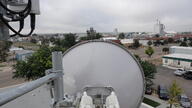
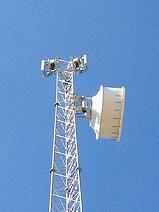
communication towerEven though there are some outdoor wireless radio systems that can do non-line-of-sight (“NLOS”), the majority of wireless backhaul requires line-of-sight (“LOS”) with proper Fresnel Zone clearance to properly operate. This means the transmitting and receiving antennas most be able to see one another with any obstructions. In most cases this requires mounting the antennas on a structure with adequate height to create LOS.

Many times when doing a point to point microwave link from one tall buildings roof top to another’s it can be easy to have LOS.
Sometimes this is not possible. Putting a antenna mast on a roof top can sometimes be sufficient. Other times it may become necessary to construct a communications tower. The first reactions that come to a client’s mind when a wireless installation vendor says a tower need to be built is no way. Several misconceptions arise. Towers are too expensive, unsightly, and are a huge construction project. Reality is that none of these are true.

Communication towers are relatively inexpensive to have installed. Leasing high speed bandwidth form a telco or installing dark fiber is extremely expensive. Point to point wireless backhaul or creating point to multipoint wireless Ethernet bridges for last mile connections have a rapid ROI (typically less than 6 months with no reoccurring costs). Adding a tower into the solutions may only add 3 to 4 months until the CAPEX achieves and ROI. Free standing towers from 40ft to 80ft in height can be installed from $15,000 to $35,000. That is not much money when you look at the big picture.

Build it and they will come! Communication towers are typically built for an initial solution but can offer great potential for future wireless backhaul projects. The tower may have been built to accommodate a point to point wireless bridge like a licensed microwave link between two locations. Now in place it may be used for other wireless Ethernet bridges or point to multipoint last mile wireless bridge connections. Odds are that if you needed to build a tower to gain some height in a geographical area other may need some height too. Leasing opportunities can come knocking on the door. Tower can create a great source of re-occurring revenue for an organization by leasing antenna space off to other parties that need a repeater location or leasing space to the mobile carriers, like At&t, Verizon, Sprint, Clearwire, etc. These opportunities can pay for the tower itself.

Roof top towerThe fact is that there are tower all around us and we just don’t even notice them. Microwave communication towers tend to blend into the skyline. So many times we hear about cosmetic concerns when it comes to mounting antennas on buildings but the fact remains that they are all around and no one ever notices them (unless you are in the wireless industry and pay attention to them). Many are less obtrusive that satellite TV dishes everyone mounts on their homes!

Microwave tower have been manufactured in ready to deploy configurations and even come with approved engineered design drawings making the permitting process simple. Communication towers used for wireless backhaul can typically be installed within a few days and offer a long term solid structure for mounting wireless backhaul antennas and equipment.


The Difference of Two Wireless Backhaul Paths

Share on Twitter Twitter | Share on Facebook Facebook | Submit to Digg digg it |  Add to delicious  delicious |  Submit to StumbleUpon StumbleUpon |  Share on LinkedIn LinkedIn |  Share On Technorati Technorati | Submit to Reddit reddit 

When considering doing a wireless installation of a point to point wireless Ethernet bridge, also known as fixed wireless backhaul, there are several options. Say you want to connect two buildings 4 miles apart and the path has good line of sight ("LOS") with proper Fresnel Zone clearance. Do you go with a licensed microwave link or an unlicensed wireless Ethernet bridge system?

The terms "unlicensed wireless bridge" and "licensed microwave link" refer to the radio frequency spectrum characteristics set by the U.S. Federal Communications Commission ("FCC") or equivalent national government regulatory body. Licensed products require regulatory approval before deployment while license-exempt products can be deployed without any regulatory approval.

Licensed microwave communication links offer true full duplex communications. Licensed microwave wireless systems are becoming more popular as a result of wireless interference in unlicensed wireless spectrum. Licensed microwave radios provide security from the risk of interference from other RF systems. In a licensed system the channels that the radio system transmits and receives on are owned by the user and are registered with the FCC for frequency coordination. Getting a license is inexpensive and can be obtained in the matter of weeks.

The most common wireless backhaul, known as a wireless Ethernet bridge, operate in the unlicensed wireless (license-exempt) 900MHz (902-928), 2.4GHz, 5.3GHz, 5.4GHz, 5.8GHz frequencies of the RF spectrum and are exempt from FCC licensing requirements. There are also 24GHz, and 60GHz wireless bridge point to point links that are considered unlicensed wireless, but are typically immune to interference. This means the system operator does not have to apply for and purchase a fixed microwave communication link license from the FCC. These systems, although quick to deploy, do not promise exclusive use of the band and are susceptible to potential interference.

Recently we had a client that was operating two wireless backhaul networks for roughly four years using two sets of Motorola PTP600 unlicensed wireless Ethernet bridges. When they were originally installed they were getting almost 300Mbps aggregate throughput (this is like having 150Mbps full duplex throughput). Over the years the wireless bridges started to get hit with interference. The PTP600 wireless backhaul radios do channel hop to try and operate on a cleaner frequency channel when they receive high levels of wireless interference. They also can down step their modulation to create a better RF communication, which also lowers the radios wireless throughput capacity. They ended up struggling with only about 30Mbps aggregate throughput due to the amount of wireless interference they were being hit with.

SAF Lumina InstallWe ended up replacing the Motorola PTP600 unlicensed 5.8GHz wireless Ethernet bridges with SAF Tehnika CFIP Lumina licensed point to point microwave links. The new wireless bridges operate in the licensed 18GHz frequency. The SAF Lumina licensed microwave links are now providing the client with 366Mbps Full Duplex (over 720Mbps aggregate) throughput. Because the SAF Lumina are licensed wireless and the frequencies are now owned by the client they are operating interference free. We were also able to downsize the antenna sizes to smaller parabolic dishes.

Unlicensed point to point wireless bridges became very popular because anyone could buy them and deploy them with little experience. Note: even unlicensed point to point wireless links should be installed by certified professionals, see my article "Outdoor Wireless Installation Done Properly". Licensed microwave communications can be daunting for those that don't understand it. Licensed microwave point to point wireless links provide far greater performance, security, and longevity. Today licensed microwave wireless bridges are about the same price as any carrier grade unlicensed point to point wireless Ethernet bridge. Licensed wireless links do need clear LOS where unlicensed wireless links can be used in nLOS applications.

If you have good LOS and want true fiber replacement on a primary network connectivity path licensed microwave links should be considered over unlicensed wireless bridges.


Understanding Microwave Communication Frequencies

Share on Twitter Twitter | Share on Facebook Facebook | Submit to Digg digg it |  Add to delicious  delicious |  Submit to StumbleUpon StumbleUpon |  Share on LinkedIn LinkedIn |  Share On Technorati Technorati | Submit to Reddit reddit 

The term "Microwave" is a broad term that covers the UHF (Ultra High Frequency with frequencies between 300MHz and 3GHz) to the EHF (Extremely High Frequency with frequencies between 30GHz to 300GHz). Licensed microwave links and unlicensed wireless Ethernet bridges typically operate in the SHF (Super High Frequency with frequencies between 3GHz to 30GHz) and the EHF bands.

Microwave Communication Tower

A general rule of thumb is that lower the frequency the farther the signal will travel. Also lower frequencies the lower the throughput and higher the frequency the higher the throughput. Again this is in general terms and depends on the wireless radio hardware used.

The terms "unlicensed wireless bridge" and "licensed microwave link" refer to the radio frequency spectrum characteristics set by the U.S. Federal Communications Commission ("FCC") or equivalent national government regulatory body. Licensed products require regulatory approval before deployment while license-exempt products can be deployed without any regulatory approval.

Licensed microwave link frequencies used for wireless backhaul in a point to point wireless backhaul operate 6GHz, 11GHz, 18GHz, 23GHz bands and the 80GHz millimeter wave E-band. Unlicensed wireless Ethernet bridges, used in point to point wireless bridges, point to multipoint wireless bridges, or wireless mesh configurations, typically operate in 900MHz, 2.4GHz, 5.3GHz, 5.4GHz, or 5.8GHz frequencies. There is also the 60GHz millimeter wave band that is used for point to point gigabit wireless bridges.

There are registered frequencies that many think are licensed but are actually unlicensed, like the 3.65GHz WiMax band used for point to multipoint wireless backhaul and the 4.9GHz Public Safety band. These registered bands do provide some protection against interference but only require local users to coordinate with one another on frequency channel coordination. This is often confused by Public Safety organizations that think the 4.9GHz band is for exclusive use by local law enforcement. Anyone can register the use of the 4.9GHz band as long as it's used for some form of public safety, such as video backhaul.

BridgeWave Proxim ResundancyLicensed microwave wireless radio systems are typically built and designed for long term solutions. Point to point licensed microwave links are true fiber replacement systems and offer full duplex wireless communications for both Ethernet and TDM. The licensed wireless bridge hardware is designed to provide carrier grade performance (high bandwidth and low latency). Because a microwave link is licensed and is not to inject and interference on other licensed microwave backhaul operators in the area they must have LOS (line of sight) and not cause heavy multipath. This is a common question of why licensed microwave radios don't use OFDM or MIMO and why they can't be used in NLOS (non line of sight) applications. In a NLOS wireless link application unlicensed wireless backhaul radios that use OFDM or MIMO take advantage of multipath for their connectivity.

Microwave communication using unlicensed wireless Ethernet bridge systems have been an extremely popular choice for outdoor wireless backhaul. The unlicensed spectrum of 5GHz (5.3GHz, 5.4GHz, and 5.8GHz UNII bands) became a primary selection by many end users and outdoor wireless installation VAR's, because of their flexibility, cost effectiveness, rapid ROI, and quick deployments. Many outdoor wireless manufactures started introducing "value line" point to point wireless Ethernet bridges using 802.11 chipsets. Basically, the same radio boards found in Wi-Fi access points put into an outdoor enclosure and using outdoor wireless antennas. The new 802.11n based wireless backhaul radios use OFDM and MIMO taking advantage of multipath, especially helpful in NLOS (non line of sight) applications. The major issue with unlicensed wireless Ethernet bridges is potential wireless interference.


Understanding Fixed Wireless Backhaul Configurations

Share on Twitter Twitter | Share on Facebook Facebook | Submit to Digg digg it |  Add to delicious  delicious |  Submit to StumbleUpon StumbleUpon |  Share on LinkedIn LinkedIn |  Share On Technorati Technorati | Submit to Reddit reddit 

Wireless backhaul, also known as fixed wireless bridges, has become a standard means of creating a microwave communication between locations; whether building to building, last mile wireless to connect remote locations to a network presence, or for connecting devices like IP video cameras, access control, SCADA devices, client devices, or phones to networks. Wireless backhaul can be deployed in several network configurations.

Fixed Wireless RepeaterA point to point wireless bridge is when only two microwave radio ends are bridged together to create a single wireless network path. Point to point wireless links are an ideal complement or replacement to leased lines and fiber. A point to point microwave link is used to create a wireless bridge network between two buildings to connect LAN connectivity or for creating a microwave link between two towers to join two WAN network segments together across large distances. Point to point wireless bridges can be licensed microwave links or unlicensed wireless Ethernet bridges and can provide throughput as low as 10Mbps up to GigE full duplex (with gigabit wireless).

Licensed microwave links used for point to point wireless backhaul operate in the 6GHz, 11GHz, 18GHz, and 23GHz frequencies and provide true full duplex wireless Ethernet and TDM communications. Licensed microwave links can provide up to 366Mbps full duplex or 732Mbps aggregate throughput using a single radio unit. Dual radio units can be combined on a single antenna to provide double the bandwidth and complete failover redundancy.

A few exceptions are the 24GHz microwave links that are unlicensed but work just like the licensed 23GHz microwave links and provide the full duplex connectivity and the 60GHz millimeter wave systems that provide up to full duplex gigabit wireless backhaul. There is also the 80GHz millimeter wave E-band that is a registered frequency that is used to provide gigabit wireless links. Unlicensed point to point wireless Ethernet bridges typically communicate in TDD because they use the same frequency channel to talk and listen. They can provide up to 300Mbps aggregate throughput.

Point to multipoint base station

Point to multipoint wireless Ethernet bridges use a hub spoke configuration using a Base Station Unit ("BSU" or "AP") that communicates with multiple Subscriber Units. This is similar to a cellular network where multiple mobile devices talk back to a cell tower location. Point to multipoint wireless backhaul systems are ideal for interconnecting campus buildings, security systems, control systems, IP video surveillance cameras, WISP applications, integrating remote business sites, or installing last mile connections. Point to multipoint wireless bridges operate in the unlicensed wireless frequency bands of 900MHz, 2.4GHz, 5.3GHz, 5.4GHz, or 5.8GHz. Point to multipoint wireless Ethernet bridges can provide up to 300Mbps aggregate throughput.

Wireless mesh configurations are used to create a wireless network where a radio node can communicate with two or more other wireless mesh nodes. Wireless mesh networks offer great redundancy. If one wireless mesh node can no longer operate, all the other wireless mesh nodes can still communicate with each other, directly or through one or more intermediate outdoor wireless bridge links. Each wireless Ethernet bridge link can send and receive messages in a wireless mesh network. Each link also functions as a router and can relay messages for its neighbors. Through the relaying process, a packet of wireless data will find its way to its destination, passing through intermediate links with reliable communication.

Mesh wireless backhaul networks are typically configured in a star topology or can be in a daisy chain configuration. They are used a lot in networks for wireless video backhaul and municipal wireless networks. Wireless mesh radios operate in unlicensed wireless backhaul frequencies like that of point to multipoint wireless bridges and can provide up to 300Mbps aggregate throughput.


The Coming Flood of Unlicensed Wireless Bridge Radios

Share on Twitter Twitter | Share on Facebook Facebook | Submit to Digg digg it |  Add to delicious  delicious |  Submit to StumbleUpon StumbleUpon |  Share on LinkedIn LinkedIn |  Share On Technorati Technorati | Submit to Reddit reddit 

If you thought wireless interference among unlicensed wireless Ethernet bridge systems is bad now, just wait. What's going to cause this flood of wireless interference is the introduction of 802.11n based, OFDM and MIMO, outdoor wireless backhaul systems. Add to the mix the amount of wireless backhaul being deployed in the IP video surveillance industry.

Wireless Interference Spectrum Analysis
Microwave communication using unlicensed wireless Ethernet bridge systems have been an extremely popular choice for outdoor wireless backhaul. Many Point to point wireless backhaul, point to multipoint wireless Ethernet bridges, wireless mesh, and outdoor Wi-Fi systems use unlicensed wireless spectrum. The unlicensed spectrum of 5GHz (5.3GHz, 5.4GHz, and 5.8GHz UNII bands) became a primary selection by many end users and outdoor wireless installation VAR's, because of their flexibility, cost effectiveness, rapid ROI, and quick deployments. Unlike a licensed microwave link, which can take several weeks to acquire a license, purchase and install, an unlicensed point to point wireless Ethernet bridge can be purchased and installed literally in a day or two.

Point to multipoint wireless backhaul and wireless mesh networks are primarily in the unlicensed 5GHz. Note: with a few exceptions of the 4.9GHz public safety band and now with the 3.65GHz WiMax backhaul spectrum. Many outdoor wireless manufactures started introducing "value line" point to point wireless Ethernet bridges using 802.11 chipsets. Basically, the same radio boards found in Wi-Fi access points put into an outdoor enclosure and using outdoor wireless antennas. The point to multipoint wireless bridge and wireless mesh backhaul systems all use the same 802.11 architecture. Some manufacture has changed the protocols to 802.16 standards or use a proprietary protocol, but they are all Atheros based (or equivalent) chipsets under the hood.

The value in these chipsets is the cost of deploying an outdoor wireless backhaul has come way down. The problem of these systems being so cheap is that many end users (non-trained outdoor wireless professionals) have started to deploy their own outdoor wireless bridges. Back in the day the wireless installation of Enterprise grade unlicensed wireless backhaul radios was done by outdoor wireless professionals that knew how to use the right antennas, power settings, and methods to help avoid wireless interference on their clients' wireless bridge as well as other wireless backhaul users in the area.

Many of the low cost wireless bridge radios come with integrated wide beam antennas (7 to 11 degree beam width on panel antennas, 30-60-90 degree beam width on sector antennas, and 360 degree omni-directional antennas) and have default power output settings set to max (which most forget to turn down where not needed).

Now with the acceptance of 802.11n chipsets there has been a mad rush by the outdoor wireless manufacturers to introduce higher bandwidth point to point wireless backhaul, point to multipoint wireless bridges, and wireless mesh systems. Why not? It's pretty amazing that you can now buy an unlicensed wireless Ethernet bridge system that can provide up to 300Mbps of aggregate throughput for under $5,000.00

So what's the issue? In my article "Wireless Interference - The Effect on Unlicensed Wireless Backhaul" we discussed how wireless interference on unlicensed wireless Ethernet bridge systems has continued to grow. The new 802.11n based wireless backhaul radios use OFDM and MIMO taking advantage of multipath, especially helpful in nlos (non line of sight) applications. They also produce a lot of multipath! They also need to use a wider channel width to obtain a higher data rate, up to 40MHz wide. Because these systems, according to manufacture specifications and marketing, can produce high aggregate throughput at an attractive price many people that didn't use outdoor wireless bridge systems are now starting to.

Wireless InterferanceAs more and more people get tempted with the thought of 100Mbps, up to 300Mbps providing an extremely fast ROI compared to a leased telco line, more and more unlicensed wireless backhaul will be deployed. The one thing that that people don't understand is that to get the full throughput the system must run at full modulation and channel width with limited wireless interference. This is something that the manufactures forget to mention. Because people are not controlling their RF signals by deploying so called plug and play outdoor wireless bridge systems and using wide beam antennas at full transmit power the amount of interference is going to explode.

Add into the mix the amount of wireless backhaul for video surveillance. Wireless video backhaul is a huge topic and growing industry. Each year at the popular industry trade event, CTIA, there is a growing number of manufactures displaying their unlicensed wireless video backhaul systems. Using wireless backhaul for video is a great application. But with the large number of unlicensed wireless Ethernet bridges being deployed and the amount that is done improperly the amount of wireless interference is bound to grow.

Should you consider an unlicensed wireless Ethernet bridge, using OFDM and MIMO? These types of outdoor wireless Ethernet bridges provide a great inexpensive solution. They work extremely well on challenging near-line-of-sight and non-line-of-sight applications. They also provide a great amount of throughput at a great price. If you need a true enterprise point to point wireless bridge and have line-of-sight (LOS) there is no substitution to a licensed microwave link, see "Licensed Microwave Wireless Backhaul."

The one thing to keep in mind is prior to considering an unlicensed wireless Ethernet bridge for microwave communication a wireless site survey, spectrum analysis, and a proper wireless path calculations should be performed. As with any point to point wireless backhaul, point to multipoint, or wireless mesh system a certified expert should perform the wireless installation.


WiMax Backhaul – What it is and what it’s not, Part 2

Share on Twitter Twitter | Share on Facebook Facebook | Submit to Digg digg it |  Add to delicious  delicious |  Submit to StumbleUpon StumbleUpon |  Share on LinkedIn LinkedIn |  Share On Technorati Technorati | Submit to Reddit reddit 

From Part 1, we described how WiMax backhaul is a point to multipoint wireless backhaul technology used to create high bandwidth wireless Ethernet bridges between a Base Station Unit (or an array of BSU's) to a Subscriber Unit (or CPE device). WiMax backhaul in the USA, according to the regulations of the FCC, is 50MHz wide of the 3.65GHz frequency band and is a non-exclusive use of microwave wireless, although a service provider must register the wireless bridge broadcast. In other countries the unlicensed wireless 3.5GHz band is common. Licensed microwave 2.5GHz is used by some carriers.

Service providers have adopted WiMax backhaul as a technology that they could readily deploy cost effectively to provide the last mile fixed wireless connectivity with greater bandwidth. It wasn't until later that WiMax backhaul evolved to the mobile carrier space. WiMax currently is a competing 4G technology to LTE (note: see article "WiMax Outdoor Wireless Bridges versus LTE Wireless Networks" for more detial). There are a lot of articles on whether WiMax and LTE truly compete or will end up being complimentary technologies providing different service benefits. The one issue with WiMax is because of the higher frequency bands it does not do well with penetrating obstructions like passing through walls of a building providing coverage indoors. The use of OFDM and MIMO do allow for (NLOS) non-line-of-sight wireless connectivity outdoors.

WiMax backhaul does not compete with the Wi-Fi standards, nor does it replace it. There will continue to be the need for Wi-Fi indoors and around campus environments to provide network connectivity to the LAN. WiMax backhaul will allow mobile device to get high speed internet from the carrier service provider companies that the devices are associated with (such as AT&T, Verizon, T-Mobile, Sprint, etc.).

The bottom line is WiMax backhaul is truly for service providers and mobile carriers. WiMax is not a solution for an end-user. The technologies used by WiMax have already been used for years now (e.g. OFDM and MIMO). WiMax is not a licensed microwave wireless solution that will completely avoid wireless interference. Nor will WiMax backhaul replace point to point wireless backhaul, licensed microwave links or unlicensed wireless Ethernet bridges. Because of the small channel width available currently, WiMax doesn't bring any higher bandwidth for an end user application. The WiMax 2 initiative takes more advantage of the use of MIMO and will provide more bandwidth, like wireless Ethernet bridges that use 802.11n chipsets today.

Today there are many systems that can produce higher wireless backhaul bandwidth by using standard unlicensed wireless Ethernet bridges compared to using WiMax as a wireless backhaul solution. Many manufactures have cashed in on the WiMax standard and have over sold its capabilities and what it's for to the end user market place.

If you are not a mobile carrier or a service provider (WISP), WiMax backhaul does not provide you any advantages over other outdoor wireless Ethernet bridge systems that have been deployed for many years now. To register WiMax is pretty difficult in many areas because many WISP and mobile carriers already have taken the spectrum. Note: see image below showing the areas already registered by service providers and mobile carriers in the Sacramento and San Francisco, CA area.

WiMax Backhaul Coverage

If you need a point to multipoint wireless backhaul solution there has been for years wireless equipment that have the same benefits of WiMax, such as OFDM and use MIMO, that can actually provide much greater bandwidth ( now up to 300Mbps).

Is WiMax good for you? As a mobile user it will provide us great wireless backhaul throughput to our mobile devices. For end users that need another internet provider solution, especially in areas where they can't get DSL, WiMax will allow service providers to provide a high quality wireless Ethernet bridge to areas that were either technically difficult or too costly to provide connectivity to. But for Government, Enterprise, or Private networks it does nothing!


WiMax Backhaul – What it is and what it’s not, Part 1

Share on Twitter Twitter | Share on Facebook Facebook | Submit to Digg digg it |  Add to delicious  delicious |  Submit to StumbleUpon StumbleUpon |  Share on LinkedIn LinkedIn |  Share On Technorati Technorati | Submit to Reddit reddit 

Many customers come to us and say that they need a wireless backhaul solution, but say they are waiting for WiMax. We ask, "Why?"

Many people that are not part of (or don't closely follow) the wireless backhaul, point to point wireless bridges or point to multipoint wireless backhaul, industry or the 4G mobile (LTE and WiMax) carrier industry really don't understand what WiMax is all about. Some think it's a Wi-Fi replacement. Others think it's a new technology that is going to replace all outdoor wireless backhaul, like licensed microwave links or wireless mesh networks. There is a lot of talk about the standards-based technology of WiMax backhaul. Many people do not know what WiMax is or what WiMax is not.

The term WiMax has become a marketing machine and has pushed the outdoor wireless backhaul industry into one the fastest growing technology industries. Just as the term Wi-Fi has been trademarked to the indoor wireless LAN market, WiMax is a trademarked term for a standards-based point to multipoint technology for the outdoor wireless backhaul market. WiMax in itself is not encompassing of all outdoor wireless backhaul. Note: image below is reported by the WiMax Forum as of Feb, 2010.

WiMax Deployments Worldwide

A General Background:
WiMax backhaul was originally designed to be a point to multipoint wireless backhaul solution for providing last mile wireless Ethernet bridges, as alternative to DSL to the home and T1 replacement to businesses. A point to multipoint wireless system consists of a base station unit ("BSU") or sometimes called an Access Point ("AP"), as a standalone or part of a cluster to provide multiple sectors of wireless backhaul coverage that provides wireless backhaul to multiple Subscriber Units ("SU"). SU's are sometimes called CPE's (customer premise equipment). This was for the WISP and telecommunication provider markets.

Part of the equation was also to make mobile devices (like laptops and mobile phones) equipped with WiMax 802.16 chipsets so they could become an actual subscriber unit, creating direct internet access through the service provider (like a giant outdoor hot spot). This would basically provide a direct wireless Ethernet bridge connection directly to a WiMax point to multipoint wireless base station array. Like a mobile phone connecting to a cellular tower.

Manufactures of outdoor wireless bridges and the WISP market realized that wireless interference is a huge issue with outdoor Ethernet wireless bridges. When you start using unlicensed wireless bridges to be a point to point wireless backhaul to unlicensed point to multipoint wireless bridges, which then provide backhaul for Wi-Fi access, in unlicensed 2.4GHz (802.11b/g/n) and 5.8GHz (802.11a/n), there is a large risk of wireless interference. At the same time many people have tried to extend Wi-Fi to outdoor environments to provide greater wireless connectivity to mobile devices, but this still needs a backhaul at some point.

WiMax backhaul was originally going to be in a frequency band away from the popular 5GHz band (5.3GHz, 5.4GHz, and 5.8GHz) used for most unlicensed wireless bridges. Unfortunately, the FCC did not allow for this. Later the FCC did open up a small piece of spectrum, 50MHz wide, of the 3.65GHz band to be used by WiMax backhaul radios. The 3.65GHz band is non-exclusive, meaning it's not a licensed microwave bridge requirement, but just a lightly regulated space that requires service providers to register the microwave wireless broadcast. The 3.5GHz band is used for WiMax backhaul wireless radios in other countries. Some mobile carriers have manufactured their own radios to operate in their licensed 2.5GHz frequencies.

For a piece of wireless backhaul equipment to be considered WiMax Certified (by the WiMax ForumTM) it must comply with the 802.16 IEEE standards and be completely interoperable with other manufactures WiMax equipment. The problem is that there are not many devices that are truly interoperable or have been fully tested to work with one another. It's funny how many of the WiMax 802.16 standards, like OFDM, were already found in the existing product lines or outdoor wireless Ethernet bridge manufactures like Proxim, Alvarion, Motorola, and others. Most WiMax equipment is almost no different than current point to multipoint wireless systems operating in the 2.4GHz or 5.8GHz unlicensed wireless bridge frequency bands. Most use OFDM and MIMO technologies. WiMax backhaul just operates in a different 3.65GHz wireless band, which provides a smaller channel width and less data throughput.

More to come in Part 2...


Non Line of Sight Point to Point Wireless Backhaul

Share on Twitter Twitter | Share on Facebook Facebook | Submit to Digg digg it |  Add to delicious  delicious |  Submit to StumbleUpon StumbleUpon |  Share on LinkedIn LinkedIn |  Share On Technorati Technorati | Submit to Reddit reddit 

Does an outdoor wireless point to point bridge require Line-of-Sight ("LOS") or can a quality wireless Ethernet bridge perform under Non-line-of-Sight ("NLOS") conditions? LOS is when both antennas in a outdoor wireless bridge system must have clear visibility with one another and have no encroachments to the first Fresnel Zone. In a NLOS situation there is either limited visibility from one wireless antenna to the other (near-line-of-sight or" nLOS") caused by a Fresnel Zone encroachment or complete obstruction blocking the visibility between the two wireless antennas.

NLOS wireless backhaul
The answer depends on the individual path and the throughput requirement. In many cases, if the wireless design and wireless installation is done properly a quality NLOS microwave link will provide good quality high bandwidth.

General Overview of Point to Point Wireless Backhaul:

A typical outdoor wireless backhaul is used to pass higher throughput over greater distances. Outdoor wireless bridges operate in the SHF (Super High Frequency) band in unlicensed wireless backhaul 5.3GHz, 4.9GHz, 5.4GHz, 5.8GHz, and 24GHz or licensed microwave backhaul 6GHz, 11GHz, 18GHz, and 23GHz. There is also unlicensed 60GHz and registered 80GHz millimeter wave in the EHF (Extreme High Frequency) band. The unlicensed wireless Ethernet bridges typically provide from 10Mbps to 300Mbps aggregate throughput. Unlicensed 24GHz and licensed microwave links offer up to 360+Mbps Full Duplex. 60GHz and 80GHz wireless bridge systems can provide up to GigE Full Duplex (gigabit wireless). The higher frequencies do not do well with penetrating obstructions.

For an outdoor wireless bridge to work the system gain must be greater that the total Path Loss. Historically, an outdoor wireless bridge required LOS providing first Fresnel Zone clearance. By having no obstructions in the first Fresnel Zone the receive signal are optimized and the out of phase signals are minimized.

General Overview of Non-Line-of Sight Wireless Bridges
When considering a point to point wireless backhaul, whether a licensed microwave link or an unlicensed wireless Ethernet bridge, one of the first questions asked is if there needs to be LOS to get a microwave link. Many don't understand the difference between wireless bridge technologies that they are use to (like cellular and cordless phones or Wi-Fi) compared to an outdoor point to point wireless Ethernet bridge.

Devices like cellular operate in a range from 800MHz to 1900MHz of the UHF (Ultra High Frequency) band. These frequencies do well with penetrating obstructions but have limited throughput capabilities. Most Wi-Fi operates in the 2.4GHz frequency of the UHF band and can provide higher bandwidth but is very limited in distance. Microwave communication signals are highly attenuated by an obstructed path. In a NLOS microwave link the RF signals will get to a destination by: diffraction around an object, reflection off objects, or by penetration through the obstruction.

For an outdoor wireless bridge, being used for high bandwidth, point to point backhaul to work in a NLOS application there are several requirements that need to be met. Proper power budget, fade mitigation, adaptive link characteristics, and proper demodulation in regards to dispersion. Because of obstructions in a NLOS situation there tends to be a large amount of multipath. Obstructions like trees add to multipath and add attenuation to the overall Path Loss of the microwave link. Trees can be tricky because they are not constant due to movement caused by wind, foliage changes during various seasons, moisture content of the foliage, etc. Constant obstructions like buildings or hills are easier to model and predict.

General Overview of NLOS Wireless Technology

Current wireless backhaul technologies can help in NLOS cases. MIMO (Multiple Input Multiple Output) antenna signaling and spatial diversity reduces the amount of fade margin required. OFDM (Orthogonal Frequency Division Multiplexing) which divides the data into several parallel data streams helping the fading that occurs with multipath. Adaptive rate modulation also helps by giving the wireless backhaul radio the ability to manage the modulation scheme and bandwidth according to the RSL (receive signal level) optimizing the microwave communication link. Outdoor wireless bridges that can take advantage of these wireless backhaul technologies are the unlicensed wireless systems. Unlicensed wireless backhaul using these technologies can provide up to 300Mbps aggregate throughput (depending again on the characteristics of the microwave link path).

A common question of why a licensed microwave link, which can provide higher, full duplex connectivity, doesn't use OFDM wireless or MIMO antenna solutions and why they can't be used in NLOS (non line of sight) applications. In a NLOS wireless link application point to point wireless Ethernet bridge radios that use OFDM or MIMO take advantage of multipath for their connectivity. Because a licensed microwave link is not to inject any interference on other licensed microwave backhaul operators in the area they must have LOS (line of sight) and not cause heavy multipath. If a licensed microwave radio was to cause a lot of wireless multipath it could potentially reflect into another existing licensed microwave communication radio belonging to another party.

Prior to considering a NLOS wireless backhaul, a wireless site survey and a proper wireless path calculation should be performed. Field test may need to be performed in order to verify if a NLOS microwave link will work or to gather accurate estimates on throughput performance. As with any point to point wireless backhaul, a certified expert should perform the wireless installation.

Wireless Interference - The Effect on Unlicensed Wireless Backhaul

Share on Twitter Twitter | Share on Facebook Facebook | Submit to Digg digg it |  Add to delicious  delicious |  Submit to StumbleUpon StumbleUpon |  Share on LinkedIn LinkedIn |  Share On Technorati Technorati | Submit to Reddit reddit 

When evaluating wireless backhaul technology, whether point to point wireless, point to multipoint wireless, or wireless mesh, the possibility of radio frequency interference disrupting a wireless link poses a concern. Interference can degrade a radio system's performance and in some cases even prevent the system from functioning at all.

For the purpose of this article "Wireless Interference" is defined as a wireless signal that alters, modifies, or disrupts the desired wireless signal as it travels from the transmitting source antenna to the receiving antenna.

Typical wireless interference is a result caused by the introduction of two or more radio waves being received into the receiving antenna from unwanted radio frequency (RF) signals disrupting the system's communication. Typically these signals are at or near the same frequency as the receive frequency of an established wireless backhaul system. The source of interference is usually from other transmitters operating very close in frequency to the impacted system or caused by "multipath" which is a result of a wireless signal reaching the receiving antenna from two or more paths.

Wireless interference can cause fading or noise on the receiving wireless antenna lowering the quality of signal. Noise is often measured by SNR ("signal to noise ratio") or a relationship of the desired signal quality to the level of undesired or corrupting signal (background noise). This can make it difficult for a wireless system to clearly understand the signal (communications) from the desired transmitting wireless radio. Interference can come into the receiving antenna either in or out of phase. The wireless backhaul system has to differentiate from the signal it should be receiving from its partnered outdoor wireless bridge from the wireless signal it is hearing from the wireless interference source.

This can be thought of in terms much like that of listening to music. Even if the music you are trying to listen to is at a desired volume but there is a lot of background noise, it can be difficult to listen to the music. The background noise can drown out the signal of the desired source causing missed bits of information. In an outdoor wireless backhaul system we see this as errors caused by dropped packets and/or multiple resends having to occur. A wireless link will have a certain threshold of wireless interference it can overcome before experiencing issues. This is often referred to a wireless system's CIR or carrier to interference ratio.

For a wireless backhaul system to operate properly it must maintain a quality receive signal level ("RSL"). Wireless bridges are designed to operate with a certain level of "Fade Margin" that allows the system to operate at a predictable reliability (for most point to point wireless systems 20 to 25dB of Fade Margin is recommended, but many point to multipoint wireless and wireless mesh systems can meet the manufactures requirements at a lower amount of Fade Margin). This means if a system has an RSL of -50dBm and it has a receiver threshold of -72dBm, you'll have 22dB of Fade Margin or the amount of dB signal strength a system can lose before you will experience errors (referred to as BER - Bite Error Ratio) or loss of connectivity.

Even if a wireless backhaul radio receiver has a good RSL the quality of the signal can be distorted by interference. A wireless bridge must have enough Fade Margin to overcome the interfering signal or have good enough CIR to function properly.

Wireless interference in regards to outdoor wireless backhaul often occurs with unlicensed wireless bridges ("license-exempt") operating in the 902-928MHz (spread spectrum), 2.4GHz, 5.3GHz, 5.4GHz, and 5.8GHz frequency bands. Note: 60GHz millimeter wave, often used in gigabit wireless backhaul, is unlicensed but is extremely immune to interference due to its inherent features of narrow beam widths and the occurrence of oxygen absorption over fairly short relative distance.

With unlicensed wireless bridges it can never be guaranteed that the wireless link will operate interference free and with any predictable reliability. Many manufactured wireless backhaul systems can help overcome interference by having a good carrier to interference ratio inherent with the hardware and by proper RF path design and wireless installation. Prior to deploying an outdoor unlicensed wireless backhaul a wireless spectrum analysis should be performed. A wireless installation company should use a proper Spectrum Analyzer to evaluate the amount of potential interfering signals in the desired frequency that is to be used (e.g. if you are deploying a 5.8GHz wireless backhaul system, as defined by the U-NII radio band of 5.725 to 5.825GHz, you would want to capture the amount of potential interference and the source of any particular wireless interference on any given channel in the 5.8GHz spectrum that will be used). A spectrum analysis will only show the amount of potential interference on the date it was taken. Other unlicensed wireless systems may be deployed at a later date that can introduce newer wireless interference.

Wireless Spectrum Analysis

Safe guards to help avoid or overcome unwanted wireless interference can be taken by choosing the appropriate wireless backhaul hardware. Using directional antennas can narrow the wireless signal's beam width, which in turn also narrows the amount listening area, while providing overall higher system gain. Using different polarizations (e.g. vertical vs. horizontal). Many of today's wireless radio systems have the ability to utilize iDFS (intelligent Dynamic Frequency Selection) that allows the wireless radio system to optimize by choosing the best wireless backhaul channel to operate on. Newer wireless bridge systems can also take advantage of using OFDM and MIMO that can help overcome interference.

Best practices should always be used by consulting an experienced outdoor wireless integrator who can perform proper spectrum analysis, path engineering and path calculations, consult on which manufacturer's equipment would be best for the solution, and perform proper wireless installation.


All Posts
Have Questions? Contact Us Signup Now Download Case Studies