
Posted by Joe Wargo on Fri, Aug 27, 2010 @ 05:09 PM
Wireless backhaul in the form of point to point microwave - licensed microwave links or unlicensed wireless Ethernet bridges, point to multipoint wireless Ethernet bridges, or wireless mesh network infrastructures can provide up to 99.999% reliability and keep you up and running when your telecommunications provider fails you.
Do you ever experience downtime on you network due to outages with your telecommunications provider, such as: AT&T, Verizon, or Comcast? What does a network outage cost you organization in dollars and man hours due to lack of productivity and internal communication or with clients? What do you say? This never happens? Think again!
You think you’re safe because you have a point to point fiber connection from your telecommunications vendor? Read my article “Outdoor Wireless Bridges or Fiber, Which Do You Trust.” What if you use an MPLS network, doesn’t that provide you failover redundancy? What about having different carriers for a backup connection? Or what about using cellular modems as a last result? Aren’t you protected by having redundancy? Not really!
The true fact is that the major telecommunications companies have outages all the time. December 11th, 2009 San Francisco experienced a several hour AT&T outage. July 21, 2010, AT&T Wireless had a regional outage for hours in NC. On April 9th, 2009 Santa Clara County, CA declared a local emergency when someone intentionally cut an underground fiber optic cable in South San Jose taking out cellular, internet, and phone usage to AT&T, Verizon, and Sprint/Nextel customers. This affected multiple cities. A local hospital had to cancel surgeries due to the emergency. Recently, Union City, CA experienced a city wide outage when central office went dark. All voice, internet, MPLS, cellular, etc. was out for almost 10 hours.
So what happens when you have no cellular, internet, data, or voice connectivity? For some organizations they have critical operations that have to be monitored so they have to be physically manned if the network goes down. What’s the cost to deploy people to remote sites or work overtime during the middle of the night? What about lost data? Some organizations can run into the millions of dollars an hour during a network outage.
Too often organizations fail to ensure their communications, both data and voice, are protected by not having appropriate redundancy or just flat out relying on a third party telecommunications vendor. Many times those who have a redundancy solution in place don’t have “True Redundancy.” Many overlook their WAN connections or have single point of failures in using the same medium (such as fiber), or taking the same external routes (out the same conduits from their MPOE), or have unknown points of failure by relying on third party telco providers’ networks. You can have MPLS but if you first connect through a local central office and that CO goes dark there is an issue. Even with backup power central office have gone dark (recently in Union City, CA) and fiber lines have been cut (San Jose, CA).
Wireless backhaul connectivity, both point to point wireless links and point to multipoint wireless bridges, provide an avenue for extremely reliable primary connections and for creating “True Redundant” network paths and connections. With both unlicensed wireless Ethernet bridges or licensed microwave links, an organization can create a completely separate stand alone network and eliminate the dependency on third parties equipment and facilities, and remove the risk of failure of fiber cuts off site and out of an organizations control.
So why own your own wireless backhaul network? Wireless backhaul, with proper wireless path engineering, the use of the right outdoor wireless backhaul equipment, and proper wireless installation can provide truly reliable networks. See articles, “Is Wireless Reliable? - The 5 Misconceptions - Part 2” and “Outdoor Wireless Installation Done Properly.”
Wireless backhaul can have multiple advantages. Wireless networks can be used for primary or redundant links. Throughput can match or even exceed that of a leased line from a telco. You can get connectivity where you can’t get it from a telco for last mile solutions. Wireless backhaul typically has an extremely low ROI and can eliminate reoccurring lease line costs. Wireless installation can be done in days compared to months of provisioning time from a telco. Also with wireless backhaul you have complete control of your network. Even in the event of equipment failure wireless nodes can be restored quickly by simply hot swapping the radio communications equipment.
That’s right no more trouble tickets from some call center agent in another country!
Posted by Joe Wargo on Sat, Aug 21, 2010 @ 03:49 PM
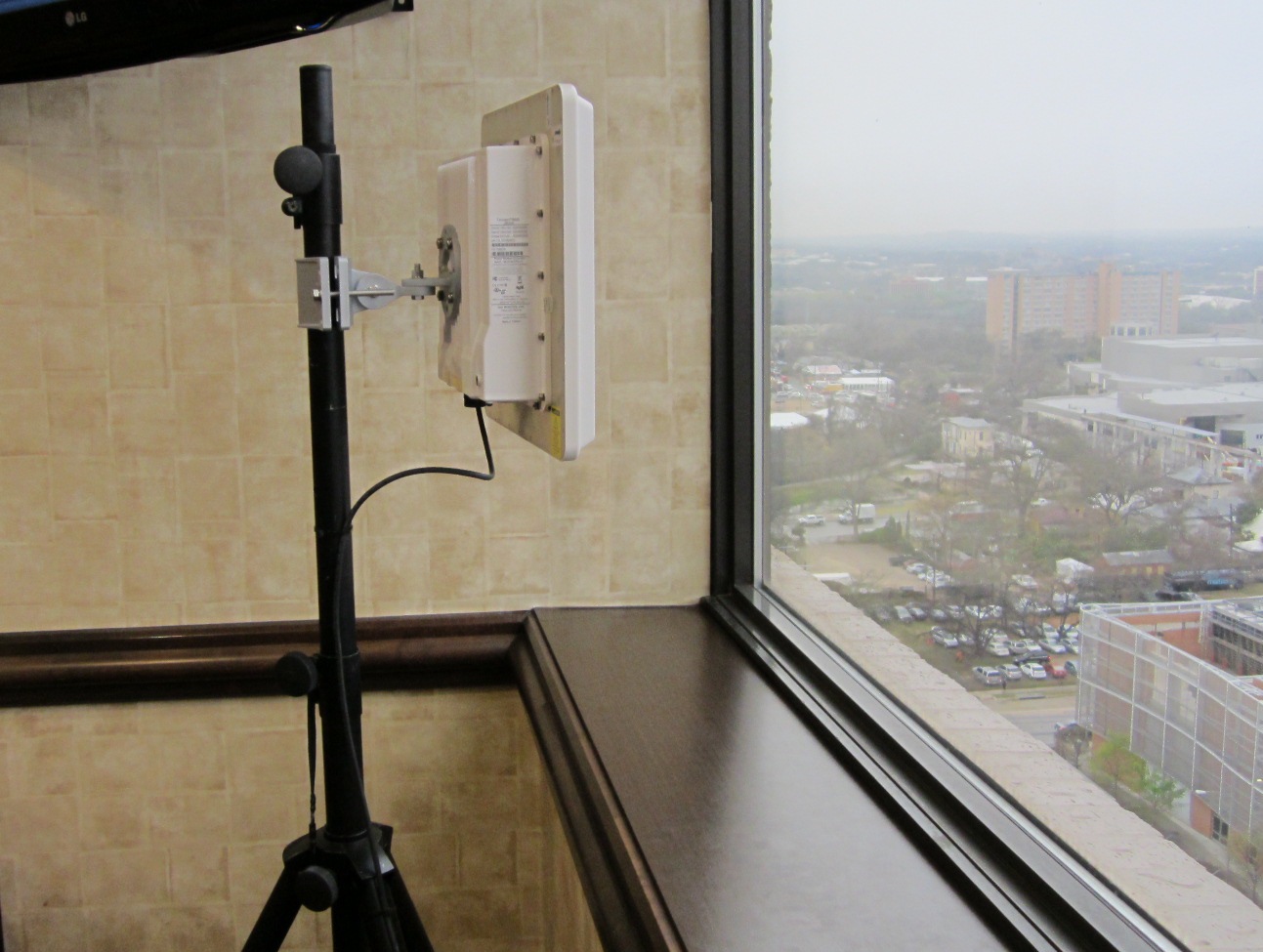
Wireless backhaul, also known as fixed wireless, technology has become a standard means of creating a data communications link between locations. Microwave radio links can be used to make data connections from building to building, to connect remote field locations to a network presence (also known as last mile wireless), connecting network fiber segments, and for connecting network devices (like IP video cameras, SCADA devices, client devices, phones, two-way radio / pagers, etc.) to networks.
Wireless backhaul can be in point to point wireless, point to multipoint wireless, or wireless mesh configurations. Wireless bridges can be licensed microwave links or unlicensed wireless Ethernet bridges. A licensed microwave link or unlicensed wireless Ethernet bridge can provide throughput as low as 10Mbps up to GigE full duplex (with gigabit wireless). There are many wireless backhaul radio platforms offering a solution to just about any application. Wireless backhaul systems can provide 99.999% reliability. A Point to point wireless Ethernet bridge or licensed microwave link can enable high capacity wireless backhaul connections from less than one mile to more than 50 miles, without performance degradation. Licensed microwave links and unlicensed wireless Ethernet bridges enable carrier class delivery of IP services with full wire-speed performance. Typical latency on a wireless Ethernet bridge or licensed microwave link is under 1ms.
Even though there are some outdoor wireless radio systems that can do non-line-of-sight (“NLOS”), the majority of wireless backhaul requires line-of-sight (“LOS”) with proper Fresnel Zone clearance to properly operate. This means the transmitting and receiving antennas most be able to see one another with any obstructions. In most cases this requires mounting the antennas on a structure with adequate height to create LOS.
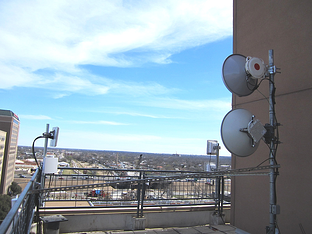
Many times when doing a point to point microwave link from one tall buildings roof top to another’s it can be easy to have LOS.
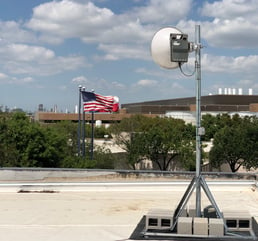
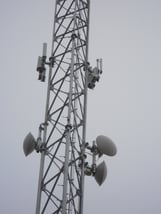
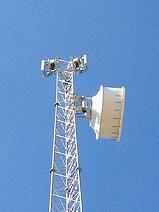
Sometimes this is not possible. Putting a antenna mast on a roof top can sometimes be sufficient. Other times it may become necessary to construct a communications tower. The first reactions that come to a client’s mind when a wireless installation vendor says a tower need to be built is no way. Several misconceptions arise. Towers are too expensive, unsightly, and are a huge construction project. Reality is that none of these are true.
Communication towers are relatively inexpensive to have installed. Leasing high speed bandwidth form a telco or installing dark fiber is extremely expensive. Point to point wireless backhaul or creating point to multipoint wireless Ethernet bridges for last mile connections have a rapid ROI (typically less than 6 months with no reoccurring costs). Adding a tower into the solutions may only add 3 to 4 months until the CAPEX achieves and ROI. Free standing towers from 40ft to 80ft in height can be installed from $15,000 to $35,000. That is not much money when you look at the big picture.
Build it and they will come! Communication towers are typically built for an initial solution but can offer great potential for future wireless backhaul projects. The tower may have been built to accommodate a point to point wireless bridge like a licensed microwave link between two locations. Now in place it may be used for other wireless Ethernet bridges or point to multipoint last mile wireless bridge connections. Odds are that if you needed to build a tower to gain some height in a geographical area other may need some height too. Leasing opportunities can come knocking on the door. Tower can create a great source of re-occurring revenue for an organization by leasing antenna space off to other parties that need a repeater location or leasing space to the mobile carriers, like At&t, Verizon, Sprint, Clearwire, etc. These opportunities can pay for the tower itself.
The fact is that there are tower all around us and we just don’t even notice them. Microwave communication towers tend to blend into the skyline. So many times we hear about cosmetic concerns when it comes to mounting antennas on buildings but the fact remains that they are all around and no one ever notices them (unless you are in the wireless industry and pay attention to them). Many are less obtrusive that satellite TV dishes everyone mounts on their homes!
Microwave tower have been manufactured in ready to deploy configurations and even come with approved engineered design drawings making the permitting process simple. Communication towers used for wireless backhaul can typically be installed within a few days and offer a long term solid structure for mounting wireless backhaul antennas and equipment.
Posted by Joe Wargo on Fri, Aug 13, 2010 @ 05:11 PM
Choosing the right outdoor wireless vendor is critical for the success of a wireless backhaul project, whether it’s a licensed microwave link, unlicensed wireless Ethernet bridge, wireless mesh, WiMax, point to point wireless backhaul, or point to multipoint wireless Ethernet bridges. Not all wireless vendors or wireless installation companies are the same. Too many companies and people claim to be RF Engineers or outdoor wireless backhaul experts without ever having any real world project experience.

Some wireless vendors are just “box movers” with a sole purpose to sell hardware. These companies typically do not have any field experience with wireless installations, wireless site surveys, or spectrum analysis. They may be able to do wireless path calculations using some software programs, but the information they use for the outdoor wireless network design is based on information they receive from the client. Because they lack any real world filed experience they tend to miss the fine intricacies that can make or break an outdoor wireless backhaul project. They also typically try and push to the customer whatever product makes them the best margins.
Some “so called” wireless vendors come with the IT networking background. They too lack any real world outdoor RF or microwave experience. They may focus on a conceptual wireless network design but have no understanding on the details of what it takes to actually install and maintain an outdoor radio system. Everything looks great on paper but when it comes time to install the system and make it work everything goes south when there is a huge groove of trees or buildings in the way! These companies might be good at the network integration portion of a project but have no clue to the way outdoor wireless systems perform in the field or what it takes to properly do a wireless installation.
There are some great outdoor wireless vendors that have a ton of outdoor radio system experience but lack any knowledge of integrating the wireless infrastructure to the client’s network.
A true outdoor wireless integrator will have in house experience with all aspects of an outdoor wireless backhaul system. A good wireless integrator will know how to properly design a wireless backhaul network, perform accurate wireless path calculations, and understand exactly what it takes to deploy a wireless backhaul network.
The good companies have experience with point to point unlicensed wireless Ethernet bridges, licensed microwave links, wireless mesh, point to multipoint wireless bridges, etc. These companies know the industry and can make appropriate recommendations on whether unlicensed wireless Ethernet bridges or licensed microwave links are right for the backhaul solutions or which is the right fit between wireless mesh and point to multipoint wireless bridges. Good wireless vendors also understand IP networking and can integrate the outdoor wireless system into the client’s network.
The good outdoor wireless integrators have experience working with towers, poles, and on roof tops. They know exactly what the mounting and power solutions need to be and what goes into the proper wireless installation of the radio equipment. True wireless integrators can properly plan, price, and insure success of an outdoor wireless backhaul project.
What about after the project? Many “so called” wireless vendors come across knowledgeable about designing a radio communication system or claim that have a lot of wireless installation experience. The question to ask is if something goes wrong or there is an issue down the road, will the wireless vendor be there for support. Did the wireless vendor rely on subcontractors for the project? Will they need to coordinate with subcontractors to support the client’s system? What will they charge to perform support if they do need to rely on a sub? These are important questions. The “so called” wireless vendors can’t control if their subs will be around in the future or what they may charge. What about the amount of time it would take to get different companies involved and dispatched?
A good wireless integrator performs all the work themselves and does not rely on subcontractors. They can take full ownership of the outdoor wireless system and can support it.
Wireless backhaul, whether you are talking about wireless mesh, WiMax, point to multipoint wireless, or point to point wireless backhaul, systems can function with extreme reliability and predictability with proper wireless network design, wireless engineering, and a quality wireless installation. The mobile wireless carriers take this matter critically and waste no expenses on ensuring their systems are installed properly. Any down time can cost them tens of thousands of dollars. The craziest thing is when organizations are willing to rely on wireless technology for their primary connectivity but pinch pennies by choosing the cheapest and many times least experienced wireless vendor or wireless installation companies for their projects.
Posted by Joe Wargo on Mon, Jun 28, 2010 @ 05:49 PM
When considering doing a
wireless installation of a
point to point wireless Ethernet bridge, also known as fixed wireless backhaul, there are several options. Say you want to connect two buildings 4 miles apart and the path has good line of sight ("LOS") with proper Fresnel Zone clearance. Do you go with a licensed microwave link or an unlicensed wireless Ethernet bridge system?
The terms "unlicensed wireless bridge" and "licensed microwave link" refer to the radio frequency spectrum characteristics set by the U.S. Federal Communications Commission ("FCC") or equivalent national government regulatory body. Licensed products require regulatory approval before deployment while license-exempt products can be deployed without any regulatory approval.
Licensed microwave communication links offer true full duplex communications. Licensed microwave wireless systems are becoming more popular as a result of wireless interference in unlicensed wireless spectrum. Licensed microwave radios provide security from the risk of interference from other RF systems. In a licensed system the channels that the radio system transmits and receives on are owned by the user and are registered with the FCC for frequency coordination. Getting a license is inexpensive and can be obtained in the matter of weeks.
The most common wireless backhaul, known as a wireless Ethernet bridge, operate in the unlicensed wireless (license-exempt) 900MHz (902-928), 2.4GHz, 5.3GHz, 5.4GHz, 5.8GHz frequencies of the RF spectrum and are exempt from FCC licensing requirements. There are also 24GHz, and 60GHz wireless bridge point to point links that are considered unlicensed wireless, but are typically immune to interference. This means the system operator does not have to apply for and purchase a fixed microwave communication link license from the FCC. These systems, although quick to deploy, do not promise exclusive use of the band and are susceptible to potential interference.
Recently we had a client that was operating two wireless backhaul networks for roughly four years using two sets of Motorola PTP600 unlicensed wireless Ethernet bridges. When they were originally installed they were getting almost 300Mbps aggregate throughput (this is like having 150Mbps full duplex throughput). Over the years the wireless bridges started to get hit with interference. The PTP600 wireless backhaul radios do channel hop to try and operate on a cleaner frequency channel when they receive high levels of wireless interference. They also can down step their modulation to create a better RF communication, which also lowers the radios wireless throughput capacity. They ended up struggling with only about 30Mbps aggregate throughput due to the amount of wireless interference they were being hit with.
We ended up replacing the Motorola PTP600 unlicensed 5.8GHz wireless Ethernet bridges with SAF Tehnika CFIP Lumina licensed point to point microwave links. The new wireless bridges operate in the licensed 18GHz frequency. The SAF Lumina licensed microwave links are now providing the client with 366Mbps Full Duplex (over 720Mbps aggregate) throughput. Because the SAF Lumina are licensed wireless and the frequencies are now owned by the client they are operating interference free. We were also able to downsize the antenna sizes to smaller parabolic dishes.
Unlicensed point to point wireless bridges became very popular because anyone could buy them and deploy them with little experience. Note: even unlicensed point to point wireless links should be installed by certified professionals, see my article "Outdoor Wireless Installation Done Properly". Licensed microwave communications can be daunting for those that don't understand it. Licensed microwave point to point wireless links provide far greater performance, security, and longevity. Today licensed microwave wireless bridges are about the same price as any carrier grade unlicensed point to point wireless Ethernet bridge. Licensed wireless links do need clear LOS where unlicensed wireless links can be used in nLOS applications.
If you have good LOS and want true fiber replacement on a primary network connectivity path licensed microwave links should be considered over unlicensed wireless bridges.
Posted by Joe Wargo on Sun, Jun 27, 2010 @ 03:39 PM
The term "Microwave" is a broad term that covers the UHF (Ultra High Frequency with frequencies between 300MHz and 3GHz) to the EHF (Extremely High Frequency with frequencies between 30GHz to 300GHz). Licensed microwave links and unlicensed wireless Ethernet bridges typically operate in the SHF (Super High Frequency with frequencies between 3GHz to 30GHz) and the EHF bands.
A general rule of thumb is that lower the frequency the farther the signal will travel. Also lower frequencies the lower the throughput and higher the frequency the higher the throughput. Again this is in general terms and depends on the wireless radio hardware used.
The terms "unlicensed wireless bridge" and "licensed microwave link" refer to the radio frequency spectrum characteristics set by the U.S. Federal Communications Commission ("FCC") or equivalent national government regulatory body. Licensed products require regulatory approval before deployment while license-exempt products can be deployed without any regulatory approval.
Licensed microwave link frequencies used for wireless backhaul in a point to point wireless backhaul operate 6GHz, 11GHz, 18GHz, 23GHz bands and the 80GHz millimeter wave E-band. Unlicensed wireless Ethernet bridges, used in point to point wireless bridges, point to multipoint wireless bridges, or wireless mesh configurations, typically operate in 900MHz, 2.4GHz, 5.3GHz, 5.4GHz, or 5.8GHz frequencies. There is also the 60GHz millimeter wave band that is used for point to point gigabit wireless bridges.
There are registered frequencies that many think are licensed but are actually unlicensed, like the 3.65GHz WiMax band used for point to multipoint wireless backhaul and the 4.9GHz Public Safety band. These registered bands do provide some protection against interference but only require local users to coordinate with one another on frequency channel coordination. This is often confused by Public Safety organizations that think the 4.9GHz band is for exclusive use by local law enforcement. Anyone can register the use of the 4.9GHz band as long as it's used for some form of public safety, such as video backhaul.
Licensed microwave wireless radio systems are typically built and designed for long term solutions. Point to point licensed microwave links are true fiber replacement systems and offer full duplex wireless communications for both Ethernet and TDM. The licensed wireless bridge hardware is designed to provide carrier grade performance (high bandwidth and low latency). Because a microwave link is licensed and is not to inject and interference on other licensed microwave backhaul operators in the area they must have LOS (line of sight) and not cause heavy multipath. This is a common question of why licensed microwave radios don't use OFDM or MIMO and why they can't be used in NLOS (non line of sight) applications. In a NLOS wireless link application unlicensed wireless backhaul radios that use OFDM or MIMO take advantage of multipath for their connectivity.
Microwave communication using unlicensed wireless Ethernet bridge systems have been an extremely popular choice for outdoor wireless backhaul. The unlicensed spectrum of 5GHz (5.3GHz, 5.4GHz, and 5.8GHz UNII bands) became a primary selection by many end users and outdoor wireless installation VAR's, because of their flexibility, cost effectiveness, rapid ROI, and quick deployments. Many outdoor wireless manufactures started introducing "value line" point to point wireless Ethernet bridges using 802.11 chipsets. Basically, the same radio boards found in Wi-Fi access points put into an outdoor enclosure and using outdoor wireless antennas. The new 802.11n based wireless backhaul radios use OFDM and MIMO taking advantage of multipath, especially helpful in NLOS (non line of sight) applications. The major issue with unlicensed wireless Ethernet bridges is potential wireless interference.
Posted by Joe Wargo on Sat, May 29, 2010 @ 03:25 PM
There is no doubt that there is a demand for
greater IP bandwidth by both the consumer and commercial enterprise. The work place across all vertical markets has become more dependent on electronic communication. The work place relies on e-mail, VoIP phones, file storage and sharing, application delivery, collaboration, reporting, IP Video, Access Control, etc. Everywhere we turn we see the consumer using the internet for entertainment, personal interaction, managing their finances, content delivery, etc.
So how are we going to deliver all the necessary bandwidth and provide internet connectivity to all areas of the country? Ask a government official or the lobbyist of the large telecommunication providers and they'll say run fiber everywhere. Sounds great but when reality hits the notion of fiber everywhere is as mythical as a unicorn. Technically can it be done? Yes if you can wait several decades and have trillions of dollars to spend and don't mind replacing it all because by the time it's all deployed it's obsolete or needs to be replaced due to deterioration.

As the USA spends millions lobbying for a fiber build out and billions more slowly deploying a fiber backhaul infrastructure the rest of the world is leap frogging us by skipping over a fiber infrastructure by rapidly deploying wireless backhaul using microwave communications and technologies like
WiMax backhaul and LTE. They are getting bandwidth in even the most remote places in the matter of months and have done so at a fraction of the cost. They also benefit from having scalable infrastructure protecting the overall CAPEX and future growth.
Here is an example: Out in a rural area if you needed to run fiber 5 miles it could take over a year and a million dollars to do so. You would need to first gain right away access to run the fiber cabling, get permits from potential multiple entities, set up long term land use agreements, install poles every 100ft in order to string the fiber along (which is cheaper than trying to trench the ground five miles to lay conduit), run the fiber and fusion splice it along the way, install expensive head end equipment on both ends, and then figure out how to spread it out from there. I guess you run even more fiber? Name a carrier that is willing to spend millions to get fiber out to a small community where it would take decades for them to get an ROI.
Wireless backhaul using microwave communications in the same scenario can be deployed in days and cost less than $100K. With a point to point wireless backhaul you do not have the need to get right away access, need permits beyond the two end points, have any need for costly infrastructure along the path, or have expensive head end equipment. From the end point you can easily spur off wireless connectivity to other locations using
point to multipoint wireless Ethernet bridges,
point to point wireless backhaul, WiMax backhaul, or
wireless mesh. This can be done in days not years and at a fraction of the cost of fiber.
The argument comes up that fiber delivers greater bandwidth. Not true. Wireless backhaul can use licensed microwave links delivering better than gigabit wireless communication and if more bandwidth is needed it's quick and simple to add more microwave links.
What about reliability? Let me ask you. What happens when a wood pole holding aerial fiber get hit by a car or knocked down in a storm. Don't laugh it happens more than you think. Even fiber in underground conduits gets destroyed. See my article "
Outdoor Wireless Bridges or Fiber, Which Do You Trust." If it's a clean break fiber can be fusion spliced back together. In most cases where a fiber pole goes down or gets ripped out by a backhoe, the fiber gets stretch and has to be replace but cutting it at two ends and a new piece fusion spliced back in. This can take hours if not days to accomplish. If a microwave radio fails it can be swapped out in the matter of hours.
A fixed wireless microwave link can go distances up to 50+ miles and provide data rates of 10Mbps full duplex to GigE Full Duplex (gigabit wireless). With proper wireless system design, a fixed wireless Ethernet bridge can provide 99.999% reliability. Wireless Ethernet bridges can be installed at a lowered throughput and later software upgraded to higher bandwidth when needed allowing for a lower wireless installation and protecting the CAPEX for future growth.
In order to get broadband across America at any reasonable time frame and at realistic costs we must turn to wireless broadband technology. The biggest hold up is the FCC opening up more spectrum for wireless backhaul.
Posted by Joe Wargo on Fri, May 28, 2010 @ 09:17 AM
Point to point wireless backhaul can be either a
licensed microwave link or an unlicensed wireless Ethernet bridge. The terms "unlicensed wireless" (also called "license exempt) and "licensed microwave" refer to the radio frequency spectrum characteristics set by the FCC or equivalent national government regulatory body. Licensed microwave communication products require regulatory approval before a wireless installation can take place while
unlicensed wireless Ethernet bridges can be deployed without any regulatory approval.
Most common unlicensed wireless bridges operate in the 900MHz, 2.4GHz, 5.3GHz, 5.4GHz, and 5.8GHz frequency bands. Unlicensed wireless backhaul is susceptible to wireless interference. See article "
Wireless Interference - The Effect on Unlicensed Wireless Backhaul." There is also millimeter wave 60GHz band used for gigabit wireless backhaul that is unlicensed. Licensed microwave links typically operate in 6GHz, 11GHz, 18GHz, and 23GHz. See article "
Licensed Microwave Wireless Backhaul." There are a few bands like 4.9GHz public safety band and the 80GHz E-Band that are registered with the FCC but are not truly licensed.
Then there is a part of the spectrum that is mostly overlooked and forgotten about. 24GHz is an unlicensed frequency that can be used for microwave communication for point to point wireless backhaul. For a wireless Ethernet bridge, 24GHz offers some great advantages. Because of the ERIP 24GHz is identical to 23GHz band and can be used for shorter range wireless links (typically under 2 miles) but it has tremendous advantages. First it's rarely used so there is virtually little to no wireless interference. Manufactures that make 24GHz microwave communication radios are those that manufacture 23GHz licensed microwave links and use the same carrier grade microwave radio platform adjusted to operate at 24GHz. As a microwave backhaul link systems can do up to 366Mbps full duplex using 256QAM at 56MHz wide channels. That's 720Mbps aggregate throughput!
Like licensed microwave links, a
point to point wireless Ethernet bridge in the 24GHz unlicensed wireless band provides carrier grade
wireless backhaul. 24GHz wireless backhaul is ideal for point to point wireless bridges in areas where there is a lot of wireless interference. The unlicensed wireless 5.8GHz band is becoming heavily saturated and it's becoming difficult to deploy wireless Ethernet bridges in many areas. Because the 24GHz band is unlicensed a
wireless installation of a 24GHz point to point wireless link can be deployed in a day without the need to wait for a FCC license.
There are many applications that need 100Mbps full duplex connectivity or greater. Millimeter wave 60GHz gigabit wireless radios are also great for shorter applications, but not ever client needs gigabit wireless connections. Most 24GHz microwave communication links can be installed as a 100Mbps full duplex wireless backhaul and can be software upgrade up to 360Mbps full duplex (720Mbps aggregate throughput) protecting the CAPEX investment.
If you need a point to point wireless backhaul that can provide 99.999% reliability, need full duplex connectivity, and are worried about wireless interference then take a look at 24GHz!
Posted by Joe Wargo on Sat, May 22, 2010 @ 04:56 PM
Is there still value in deploying a city wide outdoor wireless Wi-Fi network? Every day there the number of people that use mobile devices that are Wi-Fi enabled continues to grow. The demand for high speed connectivity to the internet is in high demand. So there is definitely a business case for it.
Many cities have tried a wireless installation to provide complete city wide Wi-Fi connectivity and have failed. In many cases the city governments, that have no staff trained and experienced in outdoor wireless backhaul and outdoor Wi-Fi systems, that tried to deploy the outdoor Wi-Fi technology rather than an outdoor wireless backhaul or mobile carrier provider, that does have experience and knowledge in mass deployments of RF and microwave communications.
Three major reasons why many of the outdoor Wi-Fi attempts failed are because there was no clear business model, projects were attempted without using highly skilled outdoor wireless installation and wireless engineering integrators, and a complete lack of understanding in the costs associated with deploying and maintaining an outdoor Wi-Fi system. Technically, it is very difficult to deploy the amount of wireless access points needed to provide complete RF coverage without causing self wireless interference. It can be done but so often wireless engineering was an afterthought when it should have been the first step.
On the other hand, WiMax backhaul promises high speed wireless connectivity to mobile devices and has already been deployed around the world with great success. WiMax backhaul, as a standard, was originally designed for outdoor wireless connectivity where Wi-Fi is a standard for indoor wireless connectivity. WiMax can cover much farther distances, requires much less infrastructure, is cheaper to deploy, wireless installation is easier, and is more cost effective to maintain. The problem is that there are not a lot of devices that are equipped with WiMax chipsets yet.
Over the years, there have been a lot of quality wireless manufactures that have come to market with outdoor wireless communication products for either outdoor Wi-Fi or WiMax solutions. Companies like Xirrus (who probably has the strongest outdoor Wi-Fi solution) and BelAir Networks have great solutions for outdoor Wi-Fi deployments. There are many others like Proxim, Motorola, and Aruba to name a few that have outdoor Wi-Fi solutions too. Companies like Alvarion, Motorola, Proxim, and Solectek to name a few make WiMax backhaul base stations and subscribers.
For the 2012 Olympics, London has declared that they will have a city wide outdoor Wi-Fi network. The services will not be offered for free but will allow tourists to stay connected to the world during the games. It is unclear who will be responsible for deploying the Wi-Fi network and who will maintain it after the Olympics. Will the City of London sell the network to an internet provider or mobile carrier or will they become a large WISP themselves. The hopes is that they will have a solid business model and will have the network designed and the wireless installation done by a credible wireless integrator. The one thing for sure is that both WiMax backhaul and outdoor Wi-Fi technology will provide a lot of benefit to the users of mobile wireless connectivity.
Posted by Joe Wargo on Thu, May 20, 2010 @ 02:57 PM
The wireless backhaul industry is booming and not just because of the build out of 4G, like WiMax backhaul and LTE. Government agencies, utilities, and private industry are all realizing the benefit of point to point wireless backhaul, point to multipoint wireless bridges, and wireless mesh. Microwave communication, also known as fixed wireless backhaul, is a great network solution because of its quick ROI, high throughput speeds, quick deployments, extreme reliability, and as a wireless last mile solution the ability to get bandwidth where traditional cable and fiber infrastructure is not available.
So how does someone that is not a wireless backhaul expert decide what the right wireless backhaul solution is and what wireless equipment to use? There are so many outdoor wireless vendors that claim their wireless hardware is the best. Who do you believe and how do you know you are getting the best solution? Whether a licensed microwave link or an unlicensed wireless Ethernet bridge, here are a few things that someone looking into a microwave communication solution should consider:
Hire a Good Outdoor Wireless Integrator
People that have deployed indoor Wi-Fi sometimes think that doing a wireless installation of an outdoor wireless backhaul is something they can do themselves. Understand that Wi-Fi is pretty easy to deploy indoors and is very forgiving. Outdoor wireless bridges are a whole other story. Outdoor wireless backhaul needs to be properly engineered. There are considerations about frequency coordination, spectrum analysis, Fresnel Zone criteria, multipath issue, signal propagation, EIRP regulations by the FCC, security, and so on. Hiring a good outdoor wireless integrator or wireless installer will ensure a successful wireless deployment. An outdoor wireless integrator can provide a proper wireless network design, perform a wireless sight survey, and help pick the right wireless hardware solution.
Understand the Solution Before Choosing the System
So many times an end user finds out that wireless backhaul might be a good solution to a networking need by a case study or white paper from a wireless manufacture. Naturally they may call the manufacture to get more information. That's where the issue starts. It becomes the particular wireless manufacture sales rep's job to fit their wireless radio system into the end user's solution, whether they are a good fit or not. The best approach it to fully understand what the wireless backhaul solution is first. Is it a point to point licensed microwave link or an unlicensed non line of sight wireless bridge that is right for the application? Once you understand what the right wireless solution is then you can look for various manufactures of that type of hardware.
Wireless Hardware Marketing Material Is Just Marketing
Marketing material is great to get an overview of a solution or piece of hardware. But understand that it's the job of a wireless manufacture to position their equipment as the best solution and sometimes the only solution. It most cases the toted performance of a wireless radio is based on optimum conditions and sometimes only achievable in a lab environment. Be sure before choosing a particular wireless backhaul platform to consult a good outdoor wireless installation VAR that works with multiple wireless manufactures and has personally installed the wireless hardware that can help decipher hype from reality.
Choose Proven and Field Tested Wireless Backhaul Systems
There is nothing better than getting positive feedback from a peer or other organization similar to yours on what type of outdoor wireless they have experienced and finding out what works and what doesn't. When you have done thousands of wireless installations you learn real quick what wireless equipment is good and what wireless systems are junk.
Know the Wireless Equipment You are Buying
There are so many outdoor wireless companies that come and go. Many wireless hardware platforms are not actually made by the so called wireless vendor. There are a handful of manufactures that OEM their wireless bridge equipment to other companies that put their label on it, change the graphics on the software and call it their own. The problem is who really knows the engineering behind the microwave radios and who can provide quality support for it. A lot of the wireless bridge equipment is cheaply made but allows for a so called wireless manufacture to make good profit margins without having any of their own R&D and testing costs.
Have a Professional Wireless Installer to Do It Right
Again, there are a lot of factors that go into a good reliable outdoor wireless backhaul system. A good wireless installer is worth their weight in gold. No matter how good the wireless hardware is, if it isn't installed properly you'll have issues (see "Outdoor Wireless Installation Done Properly").
Posted by Joe Wargo on Tue, May 11, 2010 @ 01:50 PM
If you thought wireless interference among unlicensed wireless Ethernet bridge systems is bad now, just wait. What's going to cause this flood of wireless interference is the introduction of 802.11n based, OFDM and MIMO, outdoor wireless backhaul systems. Add to the mix the amount of wireless backhaul being deployed in the IP video surveillance industry.
Microwave communication using unlicensed wireless Ethernet bridge systems have been an extremely popular choice for outdoor wireless backhaul. Many
Point to point wireless backhaul,
point to multipoint wireless Ethernet bridges,
wireless mesh, and outdoor
Wi-Fi systems use unlicensed wireless spectrum. The unlicensed spectrum of 5GHz (5.3GHz, 5.4GHz, and 5.8GHz UNII bands) became a primary selection by many end users and outdoor wireless installation VAR's, because of their flexibility, cost effectiveness, rapid ROI, and quick deployments. Unlike a
licensed microwave link, which can take several weeks to acquire a license, purchase and install, an unlicensed point to point wireless Ethernet bridge can be purchased and installed literally in a day or two.
Point to multipoint wireless backhaul and wireless mesh networks are primarily in the unlicensed 5GHz. Note: with a few exceptions of the 4.9GHz public safety band and now with the 3.65GHz WiMax backhaul spectrum. Many outdoor wireless manufactures started introducing "value line" point to point wireless Ethernet bridges using 802.11 chipsets. Basically, the same radio boards found in Wi-Fi access points put into an outdoor enclosure and using outdoor wireless antennas. The point to multipoint wireless bridge and wireless mesh backhaul systems all use the same 802.11 architecture. Some manufacture has changed the protocols to 802.16 standards or use a proprietary protocol, but they are all Atheros based (or equivalent) chipsets under the hood.
The value in these chipsets is the cost of deploying an outdoor wireless backhaul has come way down. The problem of these systems being so cheap is that many end users (non-trained outdoor wireless professionals) have started to deploy their own outdoor wireless bridges. Back in the day the
wireless installation of Enterprise grade unlicensed wireless backhaul radios was done by outdoor wireless professionals that knew how to use the right antennas, power settings, and methods to help avoid wireless interference on their clients' wireless bridge as well as other wireless backhaul users in the area.
Many of the low cost wireless bridge radios come with integrated wide beam antennas (7 to 11 degree beam width on panel antennas, 30-60-90 degree beam width on sector antennas, and 360 degree omni-directional antennas) and have default power output settings set to max (which most forget to turn down where not needed).
Now with the acceptance of 802.11n chipsets there has been a mad rush by the outdoor wireless manufacturers to introduce higher bandwidth point to point wireless backhaul, point to multipoint wireless bridges, and wireless mesh systems. Why not? It's pretty amazing that you can now buy an unlicensed wireless Ethernet bridge system that can provide up to 300Mbps of aggregate throughput for under $5,000.00
So what's the issue? In my article "Wireless Interference - The Effect on Unlicensed Wireless Backhaul" we discussed how wireless interference on unlicensed wireless Ethernet bridge systems has continued to grow. The new 802.11n based wireless backhaul radios use OFDM and MIMO taking advantage of multipath, especially helpful in nlos (non line of sight) applications. They also produce a lot of multipath! They also need to use a wider channel width to obtain a higher data rate, up to 40MHz wide. Because these systems, according to manufacture specifications and marketing, can produce high aggregate throughput at an attractive price many people that didn't use outdoor wireless bridge systems are now starting to.
As more and more people get tempted with the thought of 100Mbps, up to 300Mbps providing an extremely fast ROI compared to a leased telco line, more and more unlicensed wireless backhaul will be deployed. The one thing that that people don't understand is that to get the full throughput the system must run at full modulation and channel width with limited wireless interference. This is something that the manufactures forget to mention. Because people are not controlling their RF signals by deploying so called plug and play outdoor wireless bridge systems and using wide beam antennas at full transmit power the amount of interference is going to explode.
Add into the mix the amount of wireless backhaul for video surveillance. Wireless video backhaul is a huge topic and growing industry. Each year at the popular industry trade event, CTIA, there is a growing number of manufactures displaying their unlicensed wireless video backhaul systems. Using wireless backhaul for video is a great application. But with the large number of unlicensed wireless Ethernet bridges being deployed and the amount that is done improperly the amount of wireless interference is bound to grow.
Should you consider an unlicensed wireless Ethernet bridge, using OFDM and MIMO? These types of outdoor wireless Ethernet bridges provide a great inexpensive solution. They work extremely well on challenging near-line-of-sight and non-line-of-sight applications. They also provide a great amount of throughput at a great price. If you need a true enterprise point to point wireless bridge and have line-of-sight (LOS) there is no substitution to a licensed microwave link, see "Licensed Microwave Wireless Backhaul."
The one thing to keep in mind is prior to considering an unlicensed wireless Ethernet bridge for microwave communication a wireless site survey, spectrum analysis, and a proper wireless path calculations should be performed. As with any point to point wireless backhaul, point to multipoint, or wireless mesh system a certified expert should perform the wireless installation.